-
Olympus OM-3

The Olympus OM-3. One of the most advanced mechanical shutter cameras ever made. It is also one of the rarest OM series cameras around as it was only produced for 3 years (1983-1986). As a result it is often hoarded by collectors who sit them in glass display cases waiting for the market value to gradually increase. It’s a shame, as this is a truly amazing camera which was designed from the ground up by Yoshihisa Maitani to take full advantage of the OM system as a modern professional camera body. It deserves to be used.
The OM3 was released along side the OM4 and OM2SP, so as a result shares some similarities. However, you could probably say it’s in many ways closer related to the OM1 in that they both have a mechanical shutter. Consequently, this is one of the main reasons why the OM3 was only produced for such a short period of time. In 1983, if people wanted a mechanical shutter body they had 2 choices in the OM system – the OM-1n which was an older but tried and tested model, or the OM-3 which was brand new and considerably more expensive. Most people chose the OM-1n naturally due to the price so it was produced until 1987, outliving the OM3.
The OM-3 had a lot going for it though. With it came an increased max shutter speed of 1/2000, iso settings from 6 to 3200, and a brand new advanced metering which included the new multi-spot system (in addition to the regular single spot), which allowed the user to take a reading in the shadows and highlights then combine them both for an ideal exposure. All of this was displayed in a new Viewfinder that featured a LCD display and a light (helpful for night shooting) which displayed detailed information on light readings and shutter speed etc. Besides all of this new technology, there remained the greatest advantage of all; that by using a mechanical shutter the camera could be operated at all shutter speeds without the need of batteries.
Of course, it must be said that with this new metering technology also came issues that worked against the cameras reputation. One of the biggest was battery life. Like the OM-2SP and OM-4, there were many cameras (curiously not all) that chewed through batteries like they were candy. You can usually tell right away if your particular camera falls into this category by the need to replace the batteries after a weeks use. There is a common misconception that all of these models suffered from this problem which is completely false. I know people who have been using them for years without needed to replace batteries. I myself have been shooting an OM-2SP for well over 8 months now with used batteries and it still functions perfectly. I haven’t had enough time to test the OM-3 extensively yet, but after shooting a couple rolls (on yet again used batteries) and repeated use of the VF lights etc, it’s still holding up perfectly. On the odd chance of the batteries draining though I still can thankfully make use of the OM3’s mechanical shutter.
Getting hung up on the technicalities of these cameras can be pointless though. At the end of the day it’s about how the camera performs, and the OM-3 continues or in some ways improves the biggest advantages of the OM’s that proceeded it. This includes the gloriously large and bright viewfinder, compact body and user friendly function, attractive finish ,design and construction, and the ability to use some of the greatest lenses ever created.
I have quite a few cameras now, and the OM-3 is already among my all time favourites. However, I have to say that as good as it is, I think they’re overpriced, especially as a user camera. I’d actually have a hard time justifying paying even half of the current market price for one of these. If you’re just looking for something to get into the wonderful OM system, there are better options available to you such as the OM-1 or OM-2. But, if you’re like me and find one for a fraction of the market value, snap it up and use it!
For further reading you can can check out these links.
I’ve also tracked down the hard to find OM3 instruction manual that I have made available for download here -
Half Frame Fun!
Here are some shots from my first roll in the little Pen EF I just picked up.
Tried out some diptychs as it fits them on a regular single frame. Some obviously worked better than others, but it was still a lot of fun. I’m quite surprised how well it metered and how sharp the lens is (when its actually in focus of course).
Tri-x400 in Rodinal 1+50


-
Black Beauties
Ok, haven’t posted up any film shots for a while.. No working film scanner means no scans. So you have to suffer through a couple more shots of new cameras than have found their way to me lately.
The first is a terrific 124G. Been liking this medium format thing lately, so I’ve bought my own camera just in case I have to give the RB67 back (I’m hoping my friend forgets i have it). The Yashica 124G is a 6×6 medium format TLR that was built in between 1971 and 1986. It has a very good reputation as an entry level medium format camera with an astounding 80cm f/3.5 Yashinon lens.
There is also a non “G” model (ie. Yashica 124), that appears to sell for considerably less than the 124G. They’re actually exactly the same except for the external finish of the camera. The optics are exactly the same, and there are rumours that the 124 has stronger internal gears than the 124G. Too bad I couldn’t find a 124 anywhere for sale that was in working condition, luckily the 124G is still pretty cheap (if you look around a bit).
Here’s a quick pic of it
I also got these 2 OM’s for an offer I just couldn’t refuse.
One is in amazing condition, the other nice and brassed up. I actually have something special planned for the “roughie”.
-
Silver SP
Well, the other week I was made an offer I couldn’t refuse. The offer was to buy another Olympus SP, but this time in Silver, for a very reasonable price. Actually, an extremely reasonable price. I wasn’t in the market for another camera, let alone another SP, but somehow I convinced myself I should get another one. =/
The SP on offer came with its original case and manual, but the best bit was that it had just undergone a CLA, plus it had a modification that allows it to take modern voltage batteries without any stuffing around. These two things alone would of cost more than what I ended up buying the camera for, so I was pretty pleased. I was about to send my black SP in for a CLA anyway, so this saved me the hassle, plus i can now leave it at home and not worry about scratching the thing (well that’s how I justified the purchase). The silver one is now my user, even though it is cosmetically and functionally flawless. (I would of been happy which a scratched up user, but who am I to complain?)
So anyway, here’s a quick picture of them together below :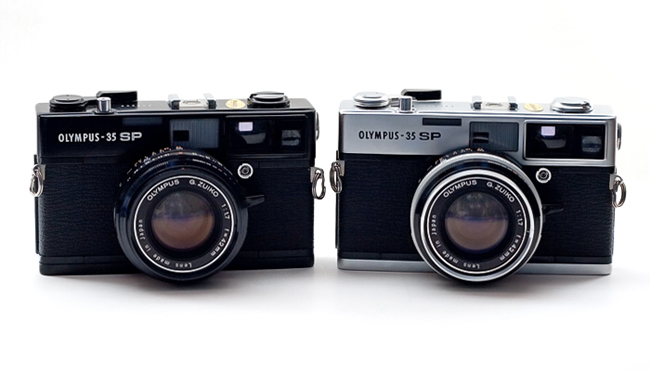
-
Olympus 35-SP
There are quite a lot of options available if you’re looking for a 70’s rangefinder. Some good, some bad, some just mediocre. This variety however produces opportunity to find something interesting or “quirky” that may suit your style or at the very least be a lasting memory of someone’s (or some committee’s) inspired design. There is one model however that stands out amongst many. The brilliant Olympus 35-SP.
Built between 1969 and 1976, this compact rangefinder packs in an unrivalled set of features that puts to shame many of even the most modern rangefinders. Its tack sharp 42mm f/1.7 G.Zuiko lens renders pictures with brilliant colour and contrast. The large bright viewfinder contains parallax error indicators and an accurate rangefinder patch. Then there’s the sophisticated metering system.
The Olympus 35-SP has the distinction of being the first ever 35mm rangefinder with dual metering options. Both centre weighted and spot metering is available to the user, which is quite amazing when you consider its age and compact size of the camera. After the SP was produced, Leica included spot metering on the Leica M5 and CL but they were already beaten to the punch, and quite frankly were inferior to the accuracy of the 6 degree spot that came with the SP. Unlike many other rangefinders from that era the light metering works in full manual mode also, which is quite useful when shooting in tricky lighting conditions or if you’re after a specific effect only manual control can produce.Besides a revolutionary metering system, the Olympus SP came with a brilliant lens mentioned earlier. This 7 element 42mm f/1.7 G.Zuiko is regarded as one of the finest rangefinder fixed lenses ever produced. The Olympus RD (which came after the SP) has a similar lens, and although a great camera in its own right it lacked the 7th correcting element. Don’t let anybody try and tell you that they’re the same lens, because they’re in a different league. The SP lens focuses down to about 2.8ft and has a super smooth focusing action with a convenient lever on the side of the barrel. All automatic and manual exposure options are contained on the barrel rings as is the timer. After a while you can adjust these without taking your eye from the viewfinder, but admittedly it will take a little practice.
So with the SP you get a bright accurate viewfinder, unrivalled metering options, one of the best rangefinder lenses ever produced, all squeezed into a tough and compact body that manages to weigh less that comparable rangefinders of that era… What more do you want??
Oh yes, it comes in a (scarce) black finish too, and I was lucky enough to find one 🙂 (picture taken with my homemade light box)
*EDIT: I just got a Silver one also, check out a picture of them together here