Reviews
-
Olympus M-1
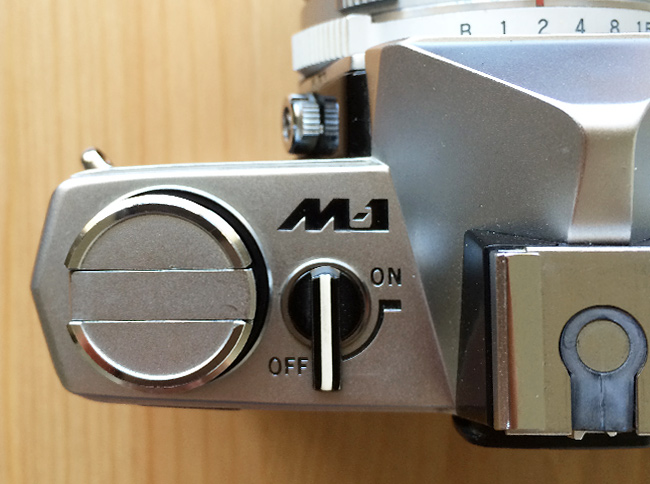
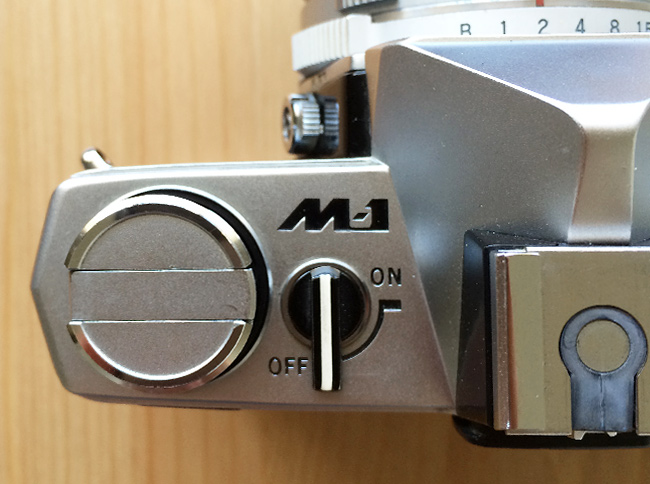
Many think of the OM-1 as the first in Olympus’ range of compact film SLR’s, however there was in fact another model that proceeded it. In July 1972 Olympus introduced the M-1. This new “M system” spearheaded by the legendary Maitani Yoshihisa, introduced a new design philosophy focused on creating compact, mechanical, fully featured professional quality SLR’s unmatched by competitors for decades. They did this my utilising smart design and modern technology, but also by fundamentally rejecting the notion that big and heavy meant quality – a misnomer still often perpetuated to this day. This philosophy began with the exceptional Pen series and concluded with the mighty XA series.
The “M system” had a very large bright viewfinder, quiet shutter, interchangeable focusing screens, accurate in camera metering all wrapped in a compact and well designed ergonomic body. The name also had a striking resemblance to Leica’s range of M mount rangefinder cameras, and for that reason Leica requested it be changed. Olympus agreed out of good will and to avoid confusion as Leica had no trademark on the name at the time (one letter names couldn’t be trademarked). Manufacture ceased in February 1973 and the name was changed to “OM” (Olympus Maitani) as it’s known today. Ironically Maitani was a great fan and long time user of Leica rangefinders, so this request was in a way a sign his new design had made an impact, particularly if Leica felt threatened about the possibility of confusion between the two systems and a need to protect their brand. Olympus’ new SLR had more in common with Leica rangefinders than just the name, their size was also very similar to the early Barnack type Leica and volume very close to that of an M Leica. To fit a pentaprism and TTL meter in a body the same size of a rangefinder was an amazing feat.
Upon release Olympus earned acclaim as manufacturer of the smallest and lightest SLR camera on the market. To achieve this Olympus developed their concept for five years, embracing technical advancements and conducting significant research in to ergonomics. It was only after management broke a design stalemate by giving in to Maitani’s vision did development seriously begin. He had a desire to “miniaturize the camera size but never the size of its button for easy handling“, proven by the fact that it could be operated easily without looking away from the viewfinder. One of the many reasons these cameras are such a pleasure to use and in my opinion superior to anything else of that era.
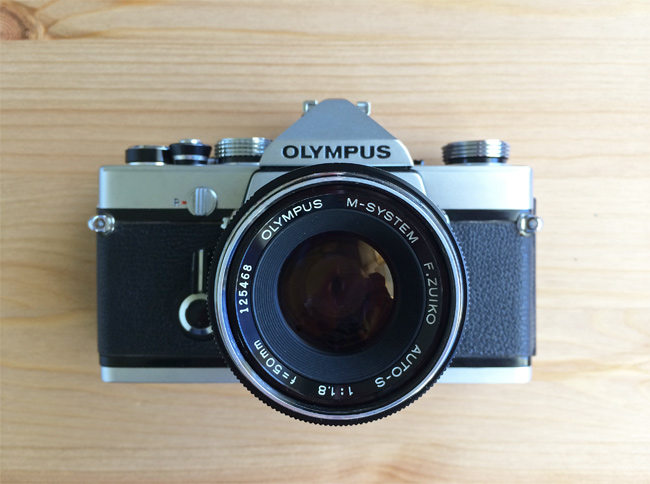
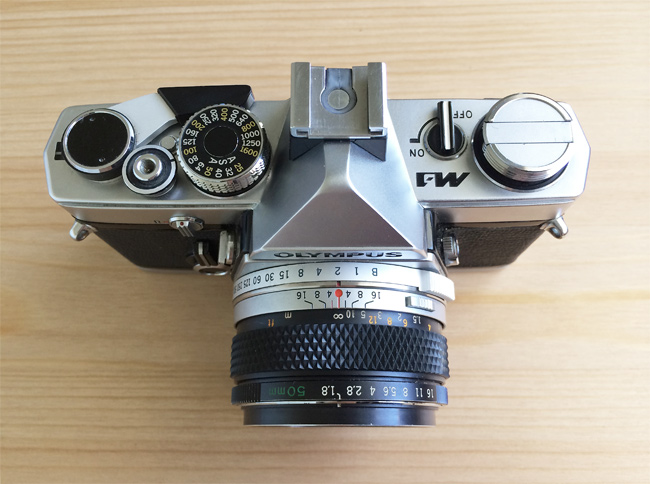
M-1 bodies are quite uncommon but their actual rarity isn’t well established. I bought mine a couple years ago in Japan and from memory they had more than one available for sale. Determining the exact number of cameras released to the public is difficult. Maitani himself said 5,000 cameras were sold and the remaining covers (with M-1 name) were mostly scrapped. However over the years since, researchers have discovered the number may in fact be closer to 50,000 according to serial number records. That said, most early models were sold in Asia and not many made it out before the name change. Over time the M system has naturally spread across the world, however if you have one that was originally delivered outside of Japan you have some something quite rare. I’ve only mentioned bodies so far, but a whole system of lenses and accessories had been designed and were beginning to be manufactured before the name change. This included a 28mm, 35mm, two 50mm’s, a very rare 55mm f/1.2 and some longer lenses ranging up to 200mm. These M system lenses are often rarer than the camera bodies themselves and may of been integrated in to normal OM kits over the years as their uniqueness is less immediately obvious. Make sure you keep an eye out for any lenses that say “M-SYSTEM” like on my camera in the image below, especially if you come across a 55m f/1.2!
Thinking of buying an M-1? Make sure you take some time to check you have the genuine article before paying a premium. There are a number of external and internal differences you should look out for even if the top plate says M-1 on it. Start by looking at the bottom plate, if there’s a motor drive cover that’s not a good sign as the OM-1 was the first model to accept this accessory. Next you can look under the film pressure plate on the back door of the camera. Here there should be three figures, the first being the plant it was made in and the second two being the year and month of manufacture respectively. We know the M-1 was built until February 1973, so for example if the displayed numbers are “32” it means you have one of the last models made. Lastly you can also look at the face of the lens mount, particularly the three screw heads that are visible. The M-1 used Flat head screws whilst other models used phillips head screws. These tips are just a start and not exhaustive, so make sure you do your research and also get as much information from the seller as possible.
So there you have it, the The Olympus M-1. There’s no good reason to seek one out over the OM-1 as they’re practically the same camera and the meter in the later models can be better. However if you want something a little unusual for those with a keen eye, or have the opportunity to rescue one from an imminent demise then don’t hesitate. They were the starting point of an SLR system that changed an industry, and offered consumers a much needed alternative in a market saturated with uninspired bulky cameras that up until then had no reason to improve and change. If you can’t tell by now I’m a big fan.
“my basic attitude toward designing a camera has always originated from the desire to take a picture. I’ll look for the necessary equipment, and if not available, make one myself“, so Maitani Yoshihisa did.

Further reading :
http://olympus.dementix.org/M-1/
http://www.olympus-global.com/en/corc/history/lecture/lecture2/ -
Olympus OM-3

The Olympus OM-3. One of the most advanced mechanical shutter cameras ever made. It is also one of the rarest OM series cameras around as it was only produced for 3 years (1983-1986). As a result it is often hoarded by collectors who sit them in glass display cases waiting for the market value to gradually increase. It’s a shame, as this is a truly amazing camera which was designed from the ground up by Yoshihisa Maitani to take full advantage of the OM system as a modern professional camera body. It deserves to be used.
The OM3 was released along side the OM4 and OM2SP, so as a result shares some similarities. However, you could probably say it’s in many ways closer related to the OM1 in that they both have a mechanical shutter. Consequently, this is one of the main reasons why the OM3 was only produced for such a short period of time. In 1983, if people wanted a mechanical shutter body they had 2 choices in the OM system – the OM-1n which was an older but tried and tested model, or the OM-3 which was brand new and considerably more expensive. Most people chose the OM-1n naturally due to the price so it was produced until 1987, outliving the OM3.
The OM-3 had a lot going for it though. With it came an increased max shutter speed of 1/2000, iso settings from 6 to 3200, and a brand new advanced metering which included the new multi-spot system (in addition to the regular single spot), which allowed the user to take a reading in the shadows and highlights then combine them both for an ideal exposure. All of this was displayed in a new Viewfinder that featured a LCD display and a light (helpful for night shooting) which displayed detailed information on light readings and shutter speed etc. Besides all of this new technology, there remained the greatest advantage of all; that by using a mechanical shutter the camera could be operated at all shutter speeds without the need of batteries.
Of course, it must be said that with this new metering technology also came issues that worked against the cameras reputation. One of the biggest was battery life. Like the OM-2SP and OM-4, there were many cameras (curiously not all) that chewed through batteries like they were candy. You can usually tell right away if your particular camera falls into this category by the need to replace the batteries after a weeks use. There is a common misconception that all of these models suffered from this problem which is completely false. I know people who have been using them for years without needed to replace batteries. I myself have been shooting an OM-2SP for well over 8 months now with used batteries and it still functions perfectly. I haven’t had enough time to test the OM-3 extensively yet, but after shooting a couple rolls (on yet again used batteries) and repeated use of the VF lights etc, it’s still holding up perfectly. On the odd chance of the batteries draining though I still can thankfully make use of the OM3’s mechanical shutter.
Getting hung up on the technicalities of these cameras can be pointless though. At the end of the day it’s about how the camera performs, and the OM-3 continues or in some ways improves the biggest advantages of the OM’s that proceeded it. This includes the gloriously large and bright viewfinder, compact body and user friendly function, attractive finish ,design and construction, and the ability to use some of the greatest lenses ever created.
I have quite a few cameras now, and the OM-3 is already among my all time favourites. However, I have to say that as good as it is, I think they’re overpriced, especially as a user camera. I’d actually have a hard time justifying paying even half of the current market price for one of these. If you’re just looking for something to get into the wonderful OM system, there are better options available to you such as the OM-1 or OM-2. But, if you’re like me and find one for a fraction of the market value, snap it up and use it!
For further reading you can can check out these links.
I’ve also tracked down the hard to find OM3 instruction manual that I have made available for download here -
Some new Books – Araki Bresson
Ok, I never really used to be into photo books that much. I mean, they were nice and everything, but I never understood the big attraction and would rather spend the money somewhere else.
However, over the last year I’ve developed bit of an appreciation for them. Especially when I’m in need of some inspiration, or just want to look at some quality photographs that aren’t displayed on a computer screen (that’s a whole other issue).
I’ve been in bit of a photographic “rut” the last couple of months. Over Christmas, by pure chance i was bought Europeans by Henri Cartier Bresson, and found a very good deal on Araki by Araki: The Photographer’s Personal Selection. Now if you can’t find any inspiration in these books you have serious issues.
Both books have an amazing collection of photographs. HCB is a master, there’s not much more than can be said about him, I love his street and figurative work. The book features some of his most famous works and quite a few I’ve never seen before. A real treat to look through.
Then there’s Araki’s book. I’ve only been looking at his work for a year or so now, but in that time I’ve noticed that people either love or hate his stuff (as opposed to HCB who just about everyone likes). I think you need to have bit of a sense of humour and actively interpret the photos in the context in which they were constructed and as part of an extensive body of work. I find much of his work interesting and so far enjoy his early stuff the most as it feels a little more natural and less constructed than his later work. I also enjoyed reading about his thoughts looking back on the photos he has in the book, what he was interested in achieving at the time, what prompted him to try a particular technique out, etc. It was a nice insight.
Here are a couple photos of the books and some pages. If you see them around, I recommend checking them out, but be warned, Araki’s book probably isn’t for the feint hearted.


-
Olympus Pen EF
The Olympus Pen EF is bit of an unusual camera. I originally saw this little guy covered in dust at a market last weekend. It stood out form the other cameras with its compact size, selenium light meter and flash. When i picked it up i noticed another interesting aspect. It’s a half frame camera. So i rescued it for $5.
As it turns out, the Pen EF is the last half frame camera released by Olympus. This is quite interesting, as it was the early 80’s at the time, and demand for the half frame format was essentially dead. Why Olympus chose to release a new model when the market was almost gone is a mystery, but i’m glad they did.
The Pen EF isn’t exactly a “pretty” camera. It looks like bit of a Frankenstein with a mixture of two eras of camera technology crammed into a very compact body. The camera epitomises simplicity. All you need to do is set the ASA (ranges from 25-400), wind the film on, then press the shutter. Thats pretty much it.
The flash is powered by a common AA battery (the camera still functions perfectly without a battery), and to activate the flash you pull a little latch down which engages it.
Besides the metering and flash, the Pen EF is lucky to benefit from a superb little 28mm D.Zuiko lens. Olympus had earnt a great reputation from their Zuiko glass for their half frame and full frame cameras, and the lens in the EF is no different. It still amazes me how manufacturers like Olympus could fit terrific little lenses in compact cameras (within a budget) that are still superior to many modern lenses that supposedly benefit from the latest and greatest technology.
Anyway, i shot a roll with this little beast the day after i got it, and it was a lot of fun. It’s quite a strange experience having 72 shots on a roll of film. I hope to create some interesting Diptychs, and also see how large I can enlarge the half frames.
If you see a little Olympus Pen EF around, don’t let it end up in the bin. It may not be the most attractive camera out there, but its certainly one of the most unique!EDIT: Some recent shots from the little Pen EF.

-
Canon P
I got this little beast a while ago now, but have only got a chance to make a post about it today.
The Canon P (“Populaire”) was made between 1958 and 1961. It’s one of Canon’s last screw mount rangefinders and regarded by many as one of the best looking rangefinders ever produced. All i know is that it works and feels great to use.
They’re were originally made as a base/basic model, but in reality were one of the last truly “bulletproof” cameras produced by Canon, so many are still working as well today as they were over 50 years ago.
There’s not too much to the camera. No light meter, so there’s no electrical issues. No fancy features that cause problems. Just a simple, clean looking camera, that works as good as it looks with a smooth film advance, and a satisfying shutter sound. The viewfinder is quite big and very bright with nice clear frame lines (maybe mine has been CLA’s recently?).
Why use a camera with no light meter and no features that make life easier? Well, its fun.
Below is a photo of mine with a Jupiter 8 attached I had lying around. The 50mm frame lines are particularly well placed in the VF, so I think a 50mm lens will live on the Canon now.
I got this camera for a steal of a price, but they regularly sell for around $100-$150, and at that price i still think they’re great value. If you want a super reliable camera, stripped back on fancy features that will take some of the greatest lenses ever created (Leica Thread Mount), then i cant think of any camera more suitable than the Canon “Populaire”.