
Olympus
-
A nice surprise
Well I started off having a pretty bad morning today before I’d even left for work. But when i got there i had a nice surprise.
I looked on my desk and saw something that I definitely didn’t leave there the previous day. It was in the shape of a crusty old looking Olympus OM1. Awesome!
See the good thing about being known as a “camera/photo guy” among friends is that when one of them sees a camera they think of you.. And this is what happened in this instance. One of the people i work with was at a garage sale earlier on. Unfortunately it was full of the usual plastic toys and old babies clothes… All useless shit (I don’t know why you’d want to buy your newly born baby some old babies clothes that the previous occupant has probably crapped in a dozen times). Anyway, that’s a whole other story.
The guy from work was at this garage sale full of useless crap when he spotted the Olympus. It was covered in dust and grime but still thought of me (hmm, maybe that’s not a good thing?). The asking price was a huge $2, so he bought it for me. I was totally taken back by the gesture as nobody has ever actually bought me an old camera, especially a good one, and especially one that i can actually use with all my other lenses etc. Generally people try to stop me buying old camera stuff and steer me away from anything that I’ll probably end up buying. So yeah, I was extremely happy, and it made my day.
The camera itself is very rough. As in, its the poorest condition camera I’ve ever owned. But I know for a fact it’ll be working perfectly it next to no time. I started off by cleaning it tonight and it’s come up wonderful. The only negative side to cleaning up the camera body is that you suddenly see all the bumps in it that were previously covered up. It was clear from the beginning that this camera will never be a show piece, but I always wanted an OM1 to use, its close to the perfect SLR.
So anyway, after cleaning the body up I thought I should check out to see if the thing actually works. The viewfinder was perfectly clean which was a relief. Then i noticed the light meter needle which was moving as I changed apertures and shutter speeds. Woohoo! That seems to be working, just not sure how accurate it is, but definitely a positive. Quickly fixed the film rewind lever that was assembled wrong (someone must of taken it apart in the past and put it back together wrong.
Next was to see if the shutter actually fired. This is where things get a little less perfect. Well, the shutter itself fires beautifully and at all different speeds. But to get the shutter to fire I need to advance the film lever which is a little strange. For some reason it wont wind fully the first go, so I’ll have to give it 1 wind and a bit for the shutter to be able to fire. Obviously it just needs an adjustment, and it actually still works fine in the end. This thing will be working perfectly soon, but i might start using it before then anyway 🙂Below is a quick picture of the beast before the clean (It actually looks a lot cleaner in the photo than in real life). I’m too tired to post up the cleaned version, so i’ll do that another time. But as you can see, the camera was pretty crappy. Oh it also came with the 50mm f/1.8 lens too which didn’t work until i took it apart also 🙂 Was definitely a learning experience as I’d never taken a lens apart and had no instructions. I managed to get all the dust out of it and clean the aperture “thingy” (technical word). It all seems to work perfectly, but will probably seize up soon, as I didn’t lubricate any of the parts when i put it back together.
So yeah, here it is so far. I’m looking forward to eventually taking some pictures with it and posting them up here.
-
Olympus 35-SP
There are quite a lot of options available if you’re looking for a 70’s rangefinder. Some good, some bad, some just mediocre. This variety however produces opportunity to find something interesting or “quirky” that may suit your style or at the very least be a lasting memory of someone’s (or some committee’s) inspired design. There is one model however that stands out amongst many. The brilliant Olympus 35-SP.
Built between 1969 and 1976, this compact rangefinder packs in an unrivalled set of features that puts to shame many of even the most modern rangefinders. Its tack sharp 42mm f/1.7 G.Zuiko lens renders pictures with brilliant colour and contrast. The large bright viewfinder contains parallax error indicators and an accurate rangefinder patch. Then there’s the sophisticated metering system.
The Olympus 35-SP has the distinction of being the first ever 35mm rangefinder with dual metering options. Both centre weighted and spot metering is available to the user, which is quite amazing when you consider its age and compact size of the camera. After the SP was produced, Leica included spot metering on the Leica M5 and CL but they were already beaten to the punch, and quite frankly were inferior to the accuracy of the 6 degree spot that came with the SP. Unlike many other rangefinders from that era the light metering works in full manual mode also, which is quite useful when shooting in tricky lighting conditions or if you’re after a specific effect only manual control can produce.Besides a revolutionary metering system, the Olympus SP came with a brilliant lens mentioned earlier. This 7 element 42mm f/1.7 G.Zuiko is regarded as one of the finest rangefinder fixed lenses ever produced. The Olympus RD (which came after the SP) has a similar lens, and although a great camera in its own right it lacked the 7th correcting element. Don’t let anybody try and tell you that they’re the same lens, because they’re in a different league. The SP lens focuses down to about 2.8ft and has a super smooth focusing action with a convenient lever on the side of the barrel. All automatic and manual exposure options are contained on the barrel rings as is the timer. After a while you can adjust these without taking your eye from the viewfinder, but admittedly it will take a little practice.
So with the SP you get a bright accurate viewfinder, unrivalled metering options, one of the best rangefinder lenses ever produced, all squeezed into a tough and compact body that manages to weigh less that comparable rangefinders of that era… What more do you want??
Oh yes, it comes in a (scarce) black finish too, and I was lucky enough to find one 🙂 (picture taken with my homemade light box)
*EDIT: I just got a Silver one also, check out a picture of them together here
-
The Olympus mju:-II (Stylus Epic)
Ok, quick question. How many cameras can you think of that satisfy the below criteria?
- compact
- rugged/all weather construction
- super sharp and contrasty fast lens
- spot metering
- auto focus
- auto film winding
- decent flash with various modes
Thought of any? Ok, now tell me how many of those come in under $20?
Is your list getting smaller? It may even be empty. If you’re lucky though you will still have one camera in mind, the mighty Olympus Mju:II. (The only other camera that might come close is the Konica Big Mini, but they’re more expensive, and I don’t have any experience with them yet).What’s wonderful about this camera is its simplicity and quality. It’s a proper point and shoot that manages to produce wonderful pictures that rival cameras many thousands for dollars more expensive. Don’t believe me? Well just go over to Flickr and check out some sample pictures.
Obviously a great camera doesn’t equal great pictures. But having something so small and inconspicuous will always give you an advantage over something big and obvious. Street photos, architecture, party snaps, the camera can do it all.
Just for the record, this camera isn’t perfect. It has some quirks that can be annoying, such as how it resets settings when you shut it down (for example, it’ll reset the flash mode you selected earlier). Trying to focus through glass can also be annoying but sometimes fixed by focusing to infinity at the sky then re-composing the shot again. Also, selecting spot metering can be fiddly. But the good points far outweigh the bad, And the truth is that this is an amazingly simple, cheap, and compact camera that takes amazing photos. It’s currently my “go everywhere” camera and if you can’t already tell I really enjoy using it. If you’re in the position to get one don’t hesitate, I’m certain you’ll get a lot out of it.* 2020 Edit: So this whole Olympus mju thing really blew up didn’t it. It’s pretty tough finding them for under $20 anymore, but if you’re lucky you can get them for under $100. Honestly though, as great as they are, I don’t think they’re worth the current market prices of $300+. That’s kind of insane.
Some shots from my First Week with the Mju:II
And here’s a Flickr group for the Mju:II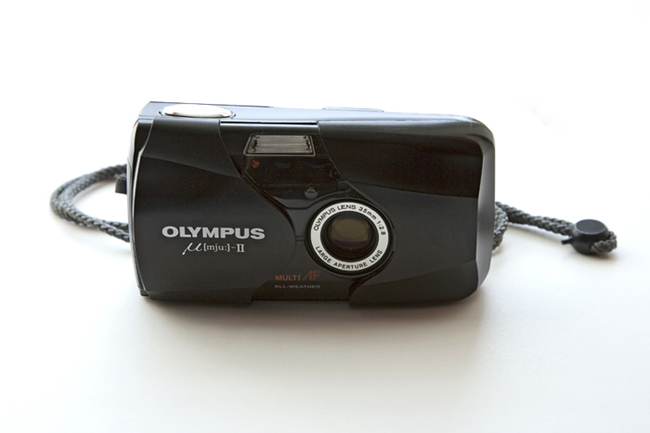
-
Some new Toys..
!!!
Finally, my Olympus 35-SP arrived in the mail! I’ve been loosing sleep over this camera the last week, worrying that it wasn’t going to turn up or get damaged in the post. Now I can breathe a sigh of relief.. It’s home, safe and sound 🙂
Also, by coincidence arrived another Olympus. It probably could be described as bit of an evolution from the mighty 35-SP, the humble little Mju-II (known as the Stylus Epic in other parts of the world). Auto everything with a reasonably fast prime lens. But I’ll give more info about both of thee cameras later on. Right now I’m going to play with them a bit!
Here’s a crappy picture of them below. Oh yeah, my SP is the harder to find black version too 🙂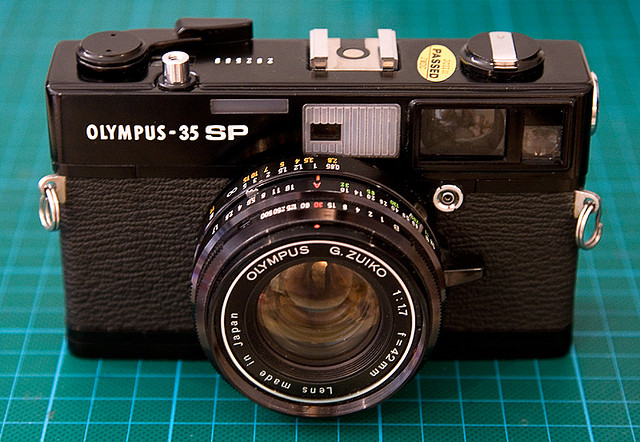
-
Olympus Trip 35 Age Explanation
The humble little Olympus Trip 35 was built between 1968 and 1984. That’s an impressive life span for a camera that remained mainly unchanged during its lifespan.
Want to find out how old yours is? The best way to discover the age of your Olympus Trip 35 isn’t by looking at its top plate serial number as some people mention from time to time, but by looking under the film pressure plate. It’s a very simple process and will only take a few minutes.
First of all you need to remove the pressure plate attached to the film door. It’s the black rectangle object in the centre of the film door you can see in the picture below.
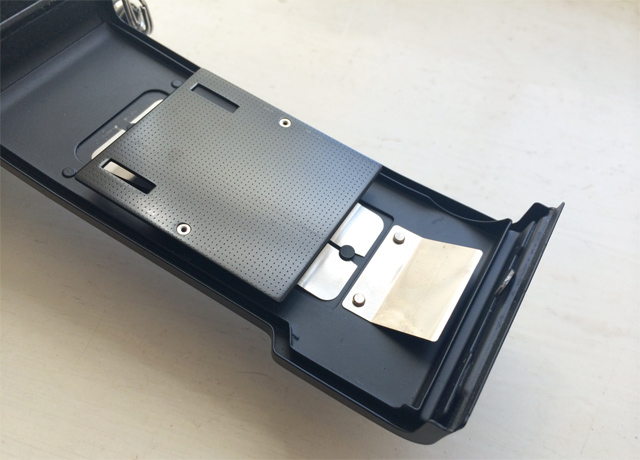
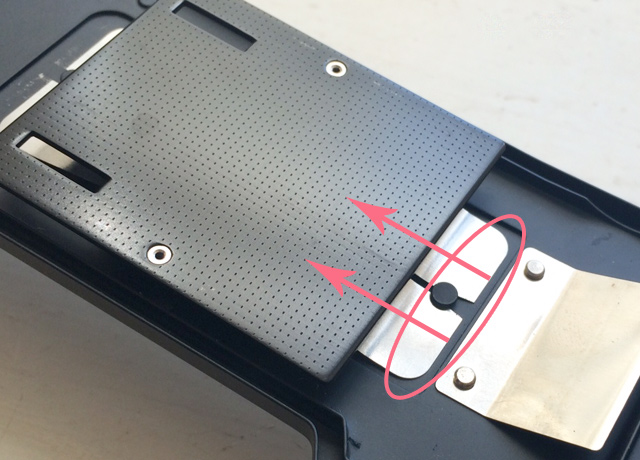
To take it off you need to slide the metal tabs off the black pins attached to the film door. Do this one side at a time by pushing the metal tab inwards using either your fingers or a flat edged screwdriver. Once you release one side, sliding out the other side is easy and now you can fully remove the pressure plate.
Now that the the plate off you can easily view the characters printed underneath, these will accurately tell you the age of your camera. The photo below shows that date stamping of one of my cameras that we’ll be using as an example :
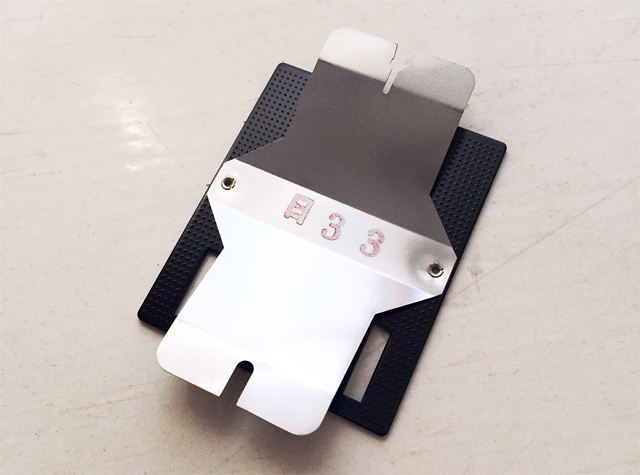
As you can see, there are 3 characters. A Japanese character and two numbers.
This is how to read it :- 1st character – The plant it was manufactured in,
- 2nd character – The last digit of the year of assembly. (so “3” = 1973, “9” = 1979, “0” = 1980, etc..),
- 3rd character – The month of assembly. (1 – 9 signifies January – September. Then X,Y,Z is for October – December).
Now the observant among you would of noticed that if you had “82” on the pressure plate it could either be February 1968 or February 1978. The way to find out what decade it belongs to is by looking at the shutter button. If it’s the chrome variety you have the earlier model, if it’s the black plastic variety you know you have the later model. I have included a photo below showing the two different types of shutter buttons. The chrome/older variety on the left, with the newer plastic shutter button on the right.
Other age identification details:
- The first black plastic shutter button models started in the second quarter of 1978.
- Earlier models had ASA 25 – 250, the latter 25 – 400.
- In 1969 and 1970 Olympus also produced a number of black bodies with black metal shutter buttons. *These demand a higher price but beware of fakes. One way of checking could be cross referencing the manufacturer year and if it doesn’t wall within ’60 or ’70 you may have a fake. This won’t work of course if they repainted a model from either of these two year but it’s a good start.
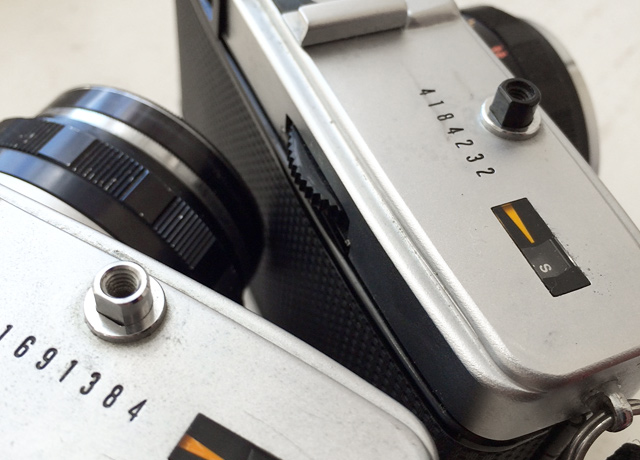
So based on all of this information I can conclude my camera above was built in March 1973. My other trip’s were built in ’69 ’74 and ’76. If you can find one from the 60’s it’s probably worth hanging onto as they’re a little more scarce. Wait a minute, who am i kidding? ALL Olympus Trips are worth hanging onto!!
*New addition! I’m the happy owner of this lovely original Olympus Trip in black paint. I think this is one of the best looking cameras Olympus ever made.

Feel free to share the age of your Olympus trip in the comments section below.